

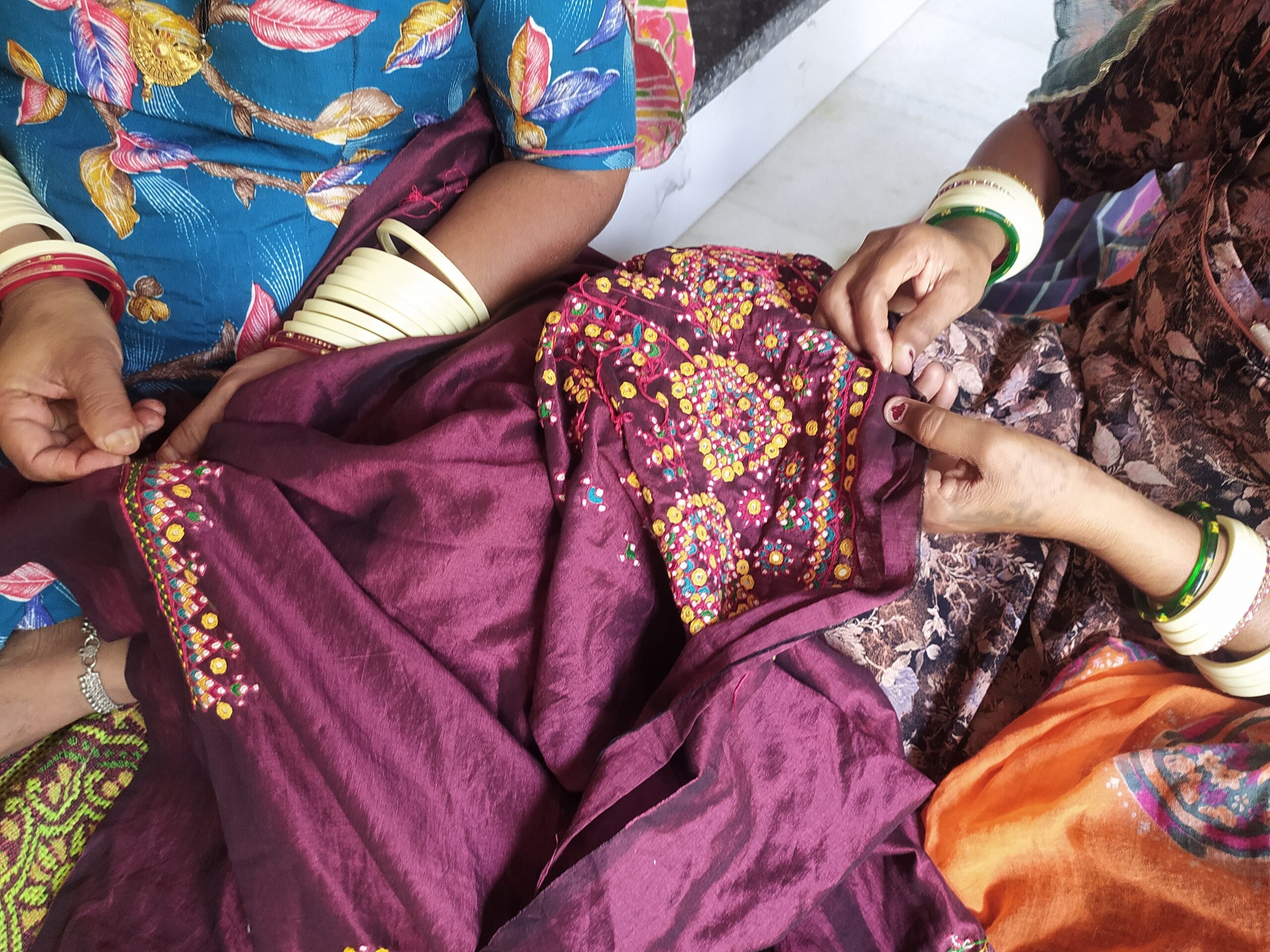
Inside a modest home in Indira Nagar, a neighborhood in the border district of Barmer in India’s western state of Rajasthan, several women gather in a small room one afternoon, preparing their needles and yarns for the hours of work ahead.
The women have gathered, as women in these villages often do, to work through a batch of orders, moving between one another’s homes to stitch, talk, and help one another along.
They work side by side, their hands carry needles tethered to brightly colored threads that dive from one stitch into the other. The intricate motifs and patterns they sew onto clothing and handkerchiefs are part of the traditional Sindhi embroidery, often passed down from grandmothers and mothers to daughters.
The embroidery fits into the edges of the day. Cooking, cleaning, washing utensils, tending livestock, and minding children fill most of the hours, and only once that work is done do the women find a few hours to sit down to the craft that has become the foundation of their income and dignity.
The women in that room are among thousands of Pakistani Hindu artisans in Rajasthan’s border districts who turned Sindhi embroidery into a livelihood after fleeing Sindh, many of them escaping religious persecution. Between 20,000 and 25,000 Pakistani migrants have settled in the state. Their handiwork feeds Rajasthan’s ₹750 crore ($100 million) handicraft export economy, recorded between April and August of 2023-24, part of India’s larger $1.8 billion handicraft sector in fiscal year 2024. Yet most of the craftswomen earn barely ₹150 a day ($1.67), far below the state’s legal minimum wage of ₹285 ($3.18) for so-called unskilled workers.
For decades, a chain of middlemen and exporters has stood between the artisans and the buyers who prize their work, setting piece rates, controlling access, and keeping most of the value the women create. Now, grassroots cooperatives are testing whether that chain can be rebuilt, and whether a craft born of displacement can become a way out of poverty rather than a trap within it.
Among the women is Neeta Devi Meghwal, whose family has carried the craft across three generations. She learned embroidery from her mother, taught it to her daughter, and has since trained her daughters-in-law.
Close-up of two women artisans’ hands creating traditional Sindhi embroidery in Barmer, Rajasthan, India. Photo courtesy of EGAB.
She recounts how her family migrated to India from Jhande Ka Tala village in Pakistan’s Sindh region during the 1971 war. The conflict, which ended in the creation of Bangladesh, also saw Indian forces occupy large stretches of Sindh’s Tharparkar