

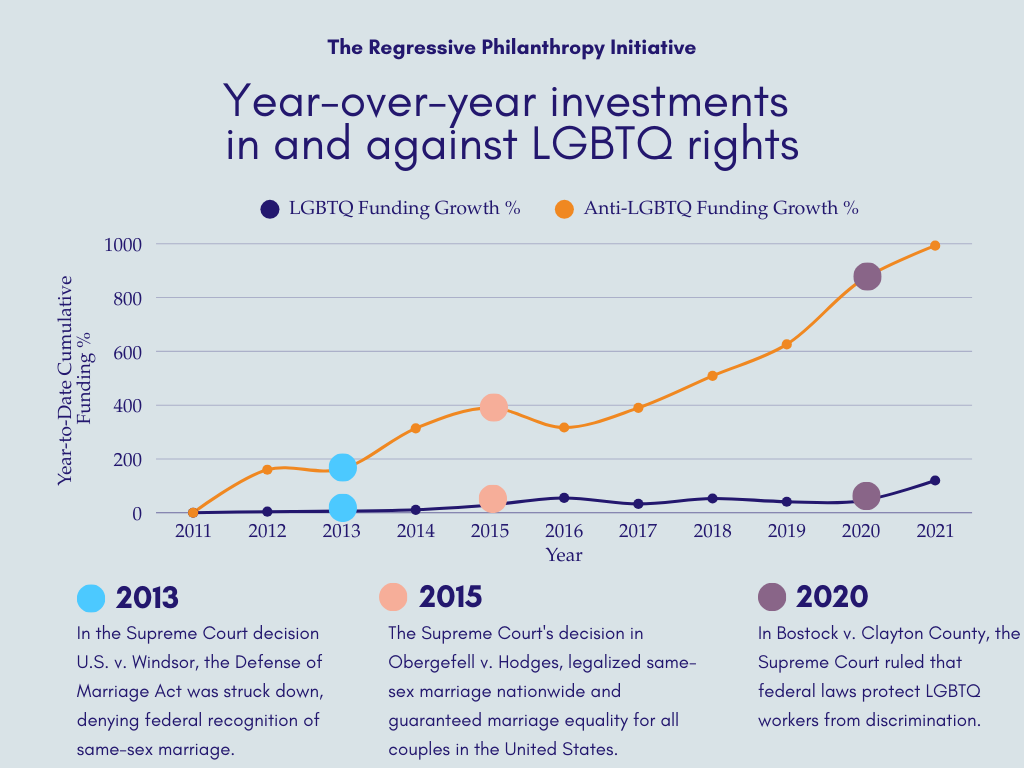
New research from the National Committee of Responsive Philanthropy explores the increased investment of regressive private and public foundations in recent years.
All figures in this reporting have been converted to 2025 dollars*
Over the past decade, we have seen the fruition of a well-financed 60-year campaign to roll back major movement-won advances made on racial, gender and economic justice. NCRP researchers took a deeper look at the investments from funders who advocated for policies and resourced organizations which undermine our democracy and basic human rights. Across our Regressive Philanthropy Initiative focus areas, NCRP researchers examined the year-over-year funding to grantees and compared it to funding contributions to movements focused on sustaining the democratic society we all want. According to the most recent data, progressive funders are still outspending regressive funders. However, the investment over time from regressive funders is far outpacing their counterparts. This is happening at an especially alarming rate, as regressive funders accelerate their efforts while other progressive funders cower in self-censorship.
Anti-LGBTQ+ organizations funding increases, while funding for LGBTQ+ communities decline
NCRP researchers compared our regressive funders dataset with the latest Tracking Report published by Funders for LGBTQ Issues. This annual report has noted a decline in U.S. foundation grantmaking to LGBTQ+ communities in recent years, falling 22% from 2022 to 2023.
Looking at the average total funding from the latest three years of our data, regressive funders on average funded $223 million annually to organizations focused on limiting rights to LGBTQ+ communities. According to the tracking report, in these same years, average funding to LGBTQ+ communities was $229 million per year. While our progressive allies remain slightly ahead of regressive funders, it is increasingly only marginal.
Even adjusted for inflation, funding for anti-LGBTQ organizations has increased significantly since 2010, escalating drastically in 2016. According to data from Funders for LGBTQ Issues, total funding for LGBTQ communities has continued to decline year-over-year since a peak in 2021.
Regressive funders work to change policy and public opinion in their anti-immigrant campaign
NCRP researchers have spent the last several years documenting the pro-immigrant and refugee movement, (PIRM) ecosystem. PIRM grants data, includes organizations across a spectrum, from core movement groups to multi-issue groups offering direct services to immigrant and refugee communities. This movement ecosystem reached an all-time funding high in 2018 with $428,964,490 in grants. NCRP’s dataset of anti-immigrant organizations is much smaller, with