

Every month we send an email newsletter to our supporters sharing recent updates from our work. We publish selected portions of the newsletter on our blog to make this news more accessible to people who visit our website. For key updates from the latest installment, please see below!
If you’d like to receive the complete newsletter in your inbox each month, you can subscribe here.
Our Safe Water Projects
More than 500,000 people die each year from diseases caused by contaminated water. We’ve been funding chlorination programs to address this for years, but we knew there were additional cost-effective opportunities out there—if we could find the right partners to implement them.
Earlier this year, we tried something new. We issued a public request for information asking organizations to propose water chlorination programs in high-burden countries. By the time the application closed, we had received more than 200 submissions.
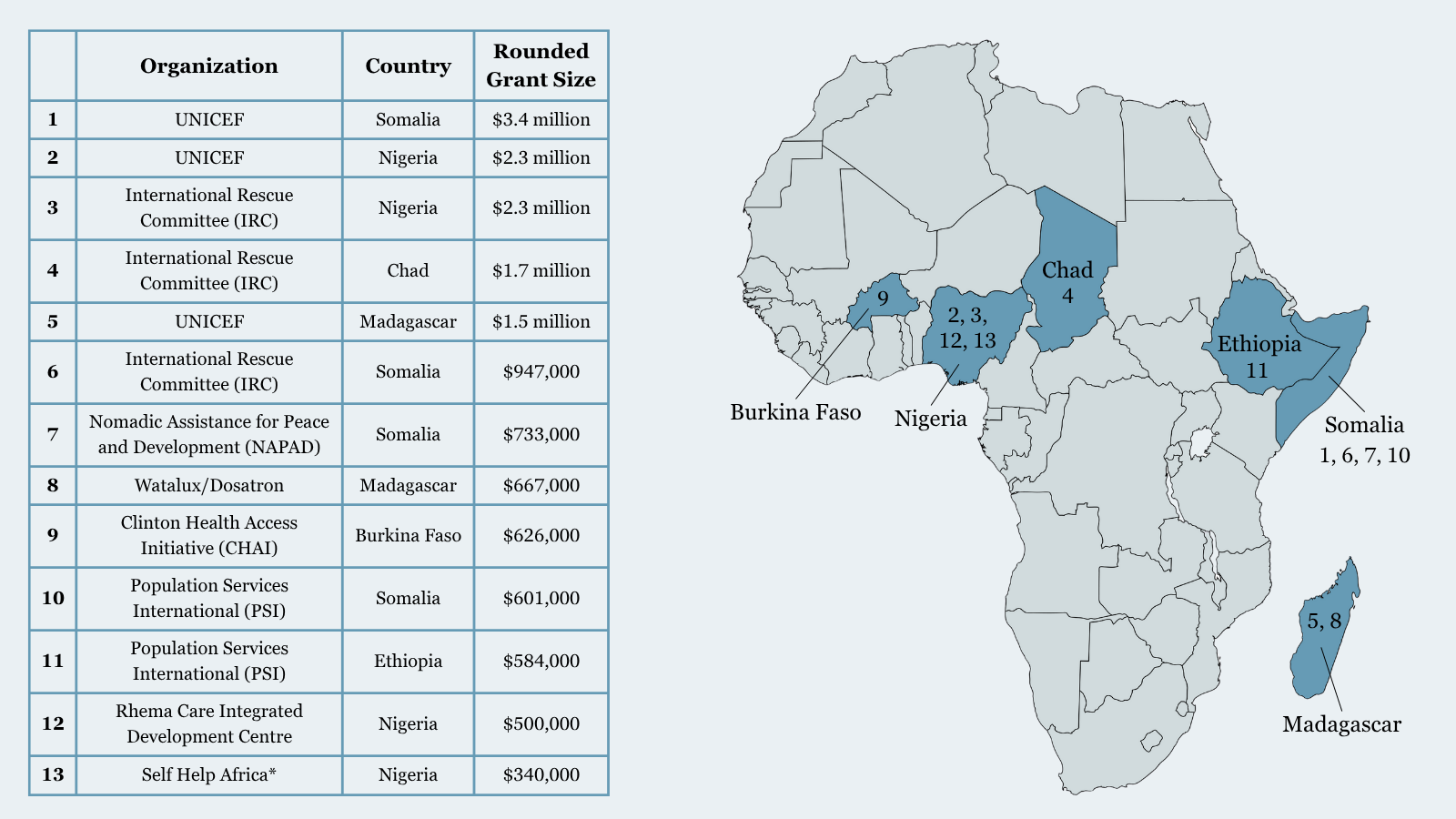
From those proposals, we built a ~$16 million portfolio of 13 pilot programs across six African countries. We intentionally selected a diverse mix—different implementing partners, chlorination devices, and contexts ranging from refugee camps to rural villages. The goal: learn as much as possible, as quickly as possible, about what works where.
*We funded Self-Help Africa’s pilot as part of our May 2025 grant to the University of California, Berkeley to conduct research on in-line chlorination, prior to making the other grants included in this portfolio. Because we think Self-Help Africa’s pilot has a high learning value (it is part of a randomized controlled trial), we did not specifically model the pilot’s cost-effectiveness or make the same adjustments to the estimated number of people reached as we did for other programs.
The map was created using MapChart.
The pilots will have a sizable direct impact. We estimate they’ll provide the equivalent of one year of safe water for 2.8 million people and avert more than 2,000 deaths, most of them children under five. But they’re also designed to answer critical questions about feasibility, device performance, and implementation models that will inform our future grantmaking.
If the successful pilots scale up, we estimate there could be more than $100 million in highly cost-effective funding opportunities in these countries alone—potentially reaching millions more people with clean drinking water.
Read the full post to learn how we selected the grants, what we hope to learn, and why some pilots might fail (and why that’s okay).
Beyond the Spreadsheets: Malawi Site Visit Podcast Series
We’re excited to share the final episode of our Beyond the Spreadsheets podcast mini-series today, which lets you ride along with our leadership team on